
Your CRM Isn’t Broken, Your Clarity Is with Aman Thakral
Most CRM failures have nothing to do with the software. They start with unclear processes, weak adoption, and buying the wrong tool for the wrong reasons.
In this episode of Sales Against the Odds, host Lee Brumbaugh sits down with Aman Thakral, Business Unit Leader for Target Integration in the US and a longtime Sales Xceleration productivity partner. Target Integration specializes in CRM and ERP integrations, cloud migrations, and AI business-ready solutions. Aman shares how the company grew from a family-run IT agency founded in Dublin, Ireland, into a CRM- and ERP-agnostic partner that helps businesses choose and implement the right system.
Aman explains why nearly 40% of CRM implementations churn, and why the problem is usually the process, not the platform. He breaks down why CRM adoption has to start at the top, how to reduce data entry so sales teams actually use the system, and how to select a CRM by mapping your process and budget first instead of listening to vendor pitches.
From his article “Your CRM Isn’t Broken, Your Clarity Is” to how AI tools are already reshaping reporting, customization, and buying behavior, Aman offers practical guidance for business owners who want to use technology to scale, close process gaps, and grow.
Key takeaways:
- Why a clear sales process must come before any CRM implementation
- How leaders drive CRM adoption by modeling it from the top down
- How to choose the right CRM based on your process, features, and budget
This has been generated by AI and optimized by a human.
Lee Brumbaugh (00:14)
Welcome everyone to another episode of Sales Against the Odds. I’m your host, Lee Brumbaugh Thank you for joining us. I am joined today by Aman Thakral. He is the business unit leader for target integration in the US. Target Integration works with ERP and CRM integrations, cloud migrations, and AI business ready solutions. They’ve been a productivity partner for us for years, and they do a great job of taking your CRM and actually making it work for you.
in a correct manner. Aman, thank you so much for joining us today.
Aman Thakral (00:46)
Thank you so much for having me today, Lee. I appreciate and I’m so glad that there was a time when I was considering to be part of SX as a productivity partner and today I’m on your podcast. So that’s a journey. Thank you so much for having us.
Lee Brumbaugh (01:00)
Yeah, absolutely, absolutely. Well tell us a little bit about before we kind of talk all things CRM tied to sales process, tell us a little bit about the evolution of target integration, where the company started with and where where you are today in your focus.
Aman Thakral (01:14)
So we are a nineteen year old agency. We started back in twenty zero eight in a city called Dublin in Ireland. So it’s a family driven business. My brother started this company uh in Ireland. He went there for his studies and then he’s the entrepreneur, believe me or not, a little family secret. I never wanted him to start this company. when he went back and he said, you know, I’m done with my job and wanna start this business, I was like, Why?
You know, we come from a humble background. I was like, stay with your job, you’re making good money. There’s no point coming in and starting an entrepreneur journey, which we all know has its own ups and downs. So I mean honestly, I didn’t want him to join this, but he did. And then later on I joined this business and since then we became a single agency which goes back and say we are agnostic around CRMs and ERP tools.
and we would help you choose the right system. We initially were not a C RM matchmaker. We were more like an IT agency who would do everything under the sky websites, social media, all of that jazz. But we realized everybody has to have niche. You know, and I’m sure SX always uh when they teach about sales, they always push us people to build their own niche. So we realise our niche should become C RMs and ERP because we are more
logical company than aesthetical. Somehow we both were not very aesthetical. Maybe Rohit is, but at least if I speak about myself, I’m not. So that’s where target integration’s vision was very clear over a period of time that now we’ll become more CRM and ERP company and we went ahead and shook hand with all the other CRMs and our experience of being an agency previously for IT services really came in handy.
Because now we can look at the whole picture starting from a sales side to implementation, your post sales, pre-sales, everything. So a holistic view that we can give to our customers.
Lee Brumbaugh (03:20)
It’s really great to hear the evolution. And and again, I know in partnering with us, you make it very real world of what you need to drive results, right? There there can be an overcomplexity, but I always appreciate that your company is just great to work with the advisor and saying what do we really need to make sure the CRM matches to the sales process. and along those lines, you’ve helped obviously a lot of SX companies implement CRM systems. When you walk into a business for the first time, what are the biggest mistakes that you consistently see of how they’re
tying in their sales process to their CRM or and and is that matching up? what do you typically see for that client that’s really in the starting journey of their CRM implementation?
Aman Thakral (03:59)
I think the biggest clarity or biggest piece that I find missing in anyone’s journey of C RMs, is that they do not have a right process. And that’s where I I look at SX being a great partner for us. It’s so it’s not a one way street where um it’s always about C R We also go back and tell people that why they should have SX. Because when somebody like
SX advisor come in, they build the whole process. People like us, those who implement CRM and ERP software, will live upon the process of the company. And most of the business owners that we realize do not really have a very good thorough process in place. Don’t take me wrong, they know their business, they’re making money, they know how to make more dollars come in their bank account every day. They are perfect in what they do. It’s just that.
You need a different mindset where you look at things very logically, very stepwise approach and can define a whole process. So believe me or not, they are almost like forty percent churn rate in CRMs, and most of them blame a CRM uh for not doing the job that they wanted the CRM to do for it. But they do they forget that this CRM is anyway working something for somebody else. So it’s not the CRM but it’s the process.
of mapping your entire business journey on a CRM is where I see the maximum problem.
Lee Brumbaugh (05:28)
So that’s very helpful and I agree with you, Mona. I mean, if you again if you don’t have a s a sales process in place of of how you go from A to B
Aman Thakral (05:34)
Yeah.
Lee Brumbaugh (05:35)
to C, it all falls apart. But even when you do, right, we often see one of the biggest challenges that pay salespeople just don’t want to use their CRM. Like we’d love to say that it’s not the case, but when you look at adoption, what can sales leaders do differently to try and get their sales teams more engaged and really adopting the sales process in the CRM and putting it into a way that’s part of their weekly and daily routine?
Aman Thakral (05:57)
So if you are a sales leader, whether you are a founder led company or it’s a bigger organization and your VP of sales or your sales uh manager, you have to understand that a CRM adaptation comes from top to bottom. What this means is you cannot just buy a CRM, implement a CRM, force your team to feed the data, but you will check reports on an Excel sheet.
it’s like kids. Monkey sees monkeys do. So if they see that their manager is not doing uh or not using CRM, boss still goes back and use Excel sheet for all the repos, they would never never feed the data. And once they will never feed the data, the adoption of C RM will never come in.
So number one, make sure if you’re buying a CRM as a business owner, as a manager, you also use the system. That’s the number one. And number two could be of course making sure all the nodes of your business are attached. Make sure if you’re focusing your CRM on leads, so the minimum you can make data entry for your team is better. If you’re running paid campaigns, make sure they are integrated with your CRM.
If you’re running any kind of campaigns, make sure the data comes into your CRM. So make sure you’re using it. Number two, make sure keep on tightening up the CRM and make people do the data entry the least.
Lee Brumbaugh (07:23)
Yeah. I can’t tell you how many times I’ve worked with a a CEO and we’re doing like a pipeline review and you know they’re coming back and asking questions of revenue. I’m like, it’s it’s in your CRM. Like we’ve built these dashboards.
Aman Thakral (07:33)
Ha ha ha
Lee Brumbaugh (07:34)
So I think you’re right. Look, the the owner needs to model it. If they’re working deals, they need to be in the system as well. They need to be
Aman Thakral (07:41)
That’s right.
Lee Brumbaugh (07:41)
pulling dashboards alongside of it. I mean, it has to go hand in hand. So when you’re a business owner and you are taking and looking at decisions.
Where do you start when if there’s a lot of CRMs that are out there, everything from very expensive Salesforce to just bottom of the, you know, very basic areas? when you’re approaching it, how should you think about selecting the right system that really is matched up correctly for your business?
Aman Thakral (08:05)
I mean stop thinking about CRM. This is what I always recommend people. I would always recommend them to think about your own business. You know, if you go to Salesforce, you go to HubSpot, everybody will blow their own trumpet and say, I am the best system. Buy me, buy me, buy me. But if you go and listen that concept of buy me, you will lead to a bigger death trap of saying, I brought this C RM, now how to use it?
So ideal recommendation is sit down with your team or somebody with SX, write your whole process down. In the process, have somebody like us come in and we come up and say, based on your process, on each of the aspects, you can involve a CRM or bring an automation. So this will give you a very confined list of features that you would want the CRM to have.
then attach the toppings of budget, you have the best CRM matching available. So you have features that you want, you have a budget that you know that you would like to spend, and they are, believe me or not, there are 250,000 CRM and ERP tools in the market. So based on the feature, based on the budget, you’ll have five six CRMs who would do what exactly that you want them to do instead of what they have to offer.
And then you start using that system, it’ll be the best match ever.
Lee Brumbaugh (10:00)
you may have a company that’s specific to a vertical that has a construction industry. They have CRMs that are specific to that. If you have if you’re looking at like your back end system and you really want it to match up and you’re a pole sailor, like I’ve got a lot of companies that worked
Aman Thakral (10:13)
Mm-hmm.
Lee Brumbaugh (10:14)
in Zoho. If you really want to run good marketing campaigns and have a cost efficient like HubSpot’s great for that. So it’s just
You know, and if you’re a five hundred million dollar company, you probably should be on sales for it. So it just it
Aman Thakral (10:24)
Absolutely.
Lee Brumbaugh (10:24)
you really do need to look at what your company needs, and then like you would any other decision, make sure it matches up to to those areas of what that that CRM can provide. you wrote an article around clarity. It said I wrote this down when I was prepping. You recently wrote it was called your CRM isn’t broken, your clarity is. And I love that perspective, right? Because everybody wants to blame the CRM.
But it’s it’s for
Aman Thakral (10:46)
Mm-hmm.
Lee Brumbaugh (10:46)
the clarity that goes into it. Talk to me about what you what you mean by that in that article and how many comp so many companies blame technology when that’s really not the underlying issue.
Aman Thakral (10:56)
Absolutely not. So I I always feel and don’t take me wrong when I have my soft corner for all the CRM companies because I feel every CRM has its own soul. And the job of their sales team, just like this job of your sales team, is to sell the CRM, they are also selling the CRM out. If as a business owner you haven’t been able to set up a right parameter to choose a right CRM, then please take the owners and blame yourself.
Don’t blame the CRM because you know they are out there. I believe CRMs are very clear with the features that they have, the things that are available. It’s you who do not have a lot of clarity of what you want to implement. so my recommendation for every business owner is always that blame your purchasing process more than the CRM or the item that you purchased, because as a business owner, owners go out to you.
So if you see that your CRM is not working, first of all, shoot the person who purchased that CRM, either you or somebody in your team. if you want to fix this error now, sit down, see what’s going wrong. CRMs do work and it’s proven by uh a lot of agencies, Gartner and things like those, they all will go back and swear by that a CRM can give you thirty three percent to fifty percent growth rate.
year on year. people like me can swear by I have seen up and down in my business and in the bad days if there’s one thing that helped me get out of the bad days was my CRM, my data bank. Because I can always go back to my same customer that I’ve served years back and say, Hey, you know, I’ve served you well. You have given me a testimonial. Can you give me more business? And it took me out. Covet was not very good time for us and
the reason we were able to sail through COVID is because of my data bank. So I always tell people that you need to bring clarity in your whole process. If you’re not able to do it, go take help from somebody. But have a process document, define different steps, define different kind of pipelines. When is the right time we are in the November season. For some people
The work is going to go dry because it’s winter coming and for some people this is the best time for you to make money. So you have to see based on your business what is the right strategy and then use technology to help you instead of blaming technology, learning how to use the technology is the time and effort they should spend on.
Lee Brumbaugh (13:33)
Yeah, it’s that’s really well put. So there’s been a lot obviously AI is the big hot button right now, but as far as how it’s impacting CRM, you know, what’s two to three years from now? Like how is AI interwoven into the CRM? Where is it really gonna be making an impact, both in the short term and the long term?
Aman Thakral (13:49)
I mean a lot of people think SaaS will die because of AI. I don’t think that. I think SaaS and software as a service, those who do not know what SaaS is, it’ll become a great complementary feature. It’ll bring world more closer to digital world, everything will be tracked, everything is digital, s which means the adaptability and acceptability of AI would be higher.
in short term goal, any emails that you need to write, you don’t have to write any kind of sequences that you need to write, you don’t need to do it anymore. You don’t have to be an expert to customize a CRM. They are tools. For example, HubSpot has something called Breeze. You just go and in a human language say, I want this kind of report.
Or you would go ahead and say, write me a customization like this, it’ll do it for you. So in a short term manner, it’s all doable. People can do more things with less of money spent and tools are very capable to do it. In a longer term, I think sky is the limit. Everything will happen, you know. Your smart watches will start talking to your CRM. So you’re walking down the lane and you can ask your city
Saying Siri, how many Leaves I got today? And you’ll get a quick answer, which is very much possible today as well, but it’s not as clean as it can be or it will be. So you can ask your data right then and there. Your CRM will track all the outputs. Your TikTok store, your Instagram handles, you will have and you know all these ray bands are coming in. Believe me or not, maybe sometimes when I sit in front of Lee.
I have my Raven glasses on and I can tell what’s Lee’s purchasing behavior have been. and I’m sure a lot of SX advisors would agree, sales is also a psychological game. So as a salesperson, if I can know the person sitting next to me and their psychology through their purchasing behavior or digital b footprints, it’ll be easier sale for me. So we are entering into all those Sky Fi movies.
That we used to watch while we were kids.
Lee Brumbaugh (16:01)
I mean, everything that we’re using from an AI is to learn more about our customers, learn buying singles.
Aman Thakral (16:05)
Right.
Lee Brumbaugh (16:06)
And the more that well, I think you’re right, you’ll see more and more of the CRM has to have, you know, I’m looking at this buying purchase based on what we’re seeing from the marketplace. This is how they typically think. So I can say this is somebody that’s a driver or it’s an analytical, and what should be in my approach to that person? We’re doing so much of of coaching using AI to coach around that disc profile or the crystal profile to that seller.
And then how do you integrate that into your selling messaging? But it it is really important and it’s impactful when you see it work. All it takes is that one rep that’s like
I use this information, help me close a deal, and then you really get that adaptation.
Aman Thakral (16:39)
I have a classic case study. as of today I’m trying to buy a car for my wife and she’s a new driver. So I’m considering to buy Mazda CX five. Believe me, what I’m doing right now, I’m using Claude and my Facebook integration. So as of today, Claude rectangly go out, search a car in Facebook marketplace and quick list. I have defined the criteria so it’ll go
Find the car, analyze the car, decide what car would fix my uh criteria. I want a clean title, less than hundred thousand miles and things like those. it’ll send the message to the seller, it’ll take the response, take the win number, compare the win number in the good car. I’ve taken a subscription, integrated this, find the right details, and then start giving them proposals and things like those. So my today’s
buying behaviour is fully integrated with Claude and it is more analytical than saying, Hey, this is the right strategy or that’s the right strategy. So I think we are entering into a era because of AI where things are more analytical than emotional and that will change a lot of buying behaviour in future.
Lee Brumbaugh (17:55)
one last thing that you’re a business owner you’re listening today and they want to improve sales performance but they don’t know where to start, what’s the biggest thing that you would say based on what you’ve seen in working with so many S B companies that they really need to to focus on? That clarity that you you spoke about earlier.
Aman Thakral (18:11)
Yeah, I think the first step would be a lot of introspection. They need to sit down with their different head of departments, different teams and come back with small things where they find a lot of pain. For example, for me as a business owner the biggest pain is a follow-up. So if follow-up is something which is not working out for me, my next plan towards automations or CRM is to make sure that my follow-ups are well taken care of.
If you see that your business spends almost five dates to create a quote for your customer, that’s the biggest challenge. So you have to bring a lot of problem statements and pain areas that you feel is missing. ideally a job of business owner is a strategic partner who’s making sure the business grows.
And they should spend more time on the strategy side. So vision has to be very clear either I’m a self employed or I’m a business owner. If you are a self-employed, you are just you know making money for yourself. But if you are a real business owner, you’re supposed to make this business scale and boom over the period of time. And the only way you can do it is adopting new and newer technology. And for that you need to first find out
pain areas where the business is lacking and then you come up to people like SX or target integration who can make sure that these gaps are filled with the better technology so that human intervention is lower and you are making more money.
Lee Brumbaugh (19:44)
Yeah, I think that’s really well put. I mean, we do all this work around sales process and funnel, and ultimately it’s to to tell you this is the step in your funnel that is not working for you. And then you have to be
Aman Thakral (19:54)
Yeah.
Lee Brumbaugh (19:55)
the business owner though, the change in pivot. Like you said, it could be that quote, you know, if we’re at five days, how do we go down to three days? If we’re, you know, if our follow up should be within, we all agree it should within two hours and we’re averaging five hours, how do we make those changes? So all of it is identification using the technology to make an identification that
That helps you serve the customer better. That’s what we’re trying to do, right? What are our customers? What is the best customer experience that we can give them on a product and service side? And how do we use the resources and technology that we have to support that journey? So I think that’s really well put. Well, Aman, this has been great. Thank you so much. Again, we we appreciate you. You’ve been a partner for us. recommend all the work you’ve done. Thank you for being on the forefront of really getting in the weeds with SMB companies.
helping them find solutions that help grow their business and like you said, bringing clarity around it.
Aman Thakral (20:44)
Thank you so much Lee and I honestly appreciate the relationship that S X and T I has it. I really wanna thank each advisor, the Essex home office, Mora and everybody. Thank you so much for the partnership and and we are so happy to have a relationship with SX.
Lee Brumbaugh (21:01)
Thanks everybody for joining us. It’s been another episode of Sales Against the Odds. Join us in a couple of weeks where we’ll have another business thought leader that challenges our perspective and helps us grow. Thanks
Our Recent Podcasts
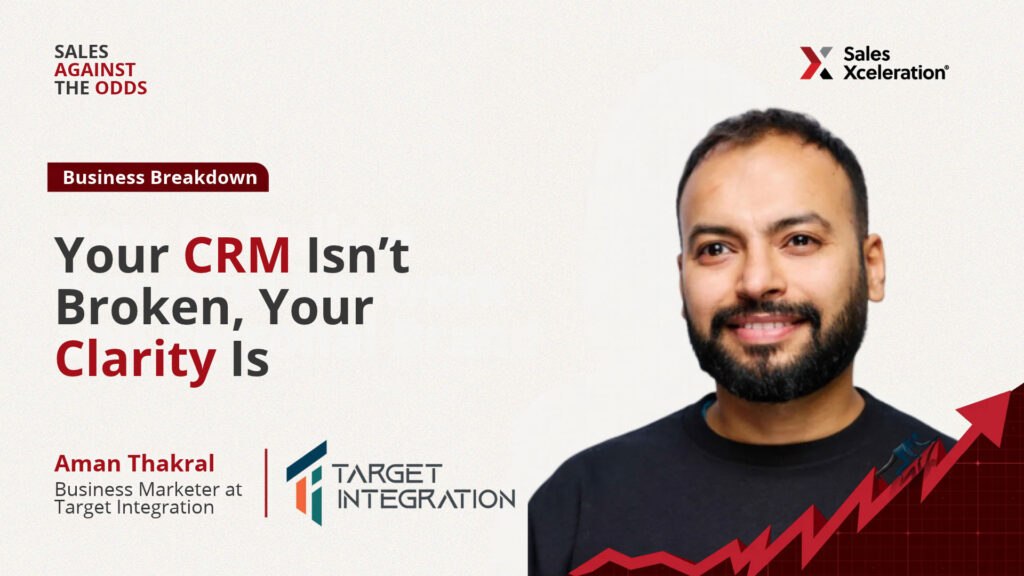
Your CRM Isn’t Broken, Your Clarity Is with Aman Thakral
Stop Hiring the Wrong Sales Person – Part 1
How to Build Amazing Teams Ready to Scale with Derrick Smith
Related Articles



Subscribe
Share This Episode
Episode Highlights
(00:00) Introduction
(01:14) The evolution of Target Integration
(03:59) The biggest CRM mistake: no defined process
(05:57) Driving CRM adoption from the top down
(08:05) How to select the right CRM for your business
(10:56) Your CRM isn’t broken, your clarity is
(13:49) How AI will shape CRM in the short and long term
(16:39) Buying a car with AI: how buying behavior is changing
(18:11) Where business owners should start to improve sales performance
About the Guest

About the Host
