
How Consultative Selling Builds Customer Trust with Larry Freedman
Great salespeople do more than build relationships. They know how to challenge customers, uncover real needs, and turn conversations into action.
In this episode of Sales Against the Odds, host Lee Brumbaugh sits down with Larry Freedman, Founder of Inspire Impact Consulting and a sales leader with more than 30 years of experience at AstraZeneca and Sanofi. Larry shares what separates strong sales leaders from average ones, including how to balance support with accountability and coach teams to sell more consultatively.
Larry explains why product knowledge, selling skills, and relationship building all matter, and why strong relationships alone are not enough. He breaks down how sellers get stuck in the “friend zone,” why listening more leads to better customer conversations, and how asking the right questions can uncover needs and move opportunities forward.
From coaching sales leaders in the field to using AI for research and targeting, Larry shares practical ways to sharpen sales execution, challenge the status quo, and help customers take action.
Key takeaways:
- Why great sales leaders balance support with accountability
- Why challenging the status quo helps customers move toward action
- How consultative selling turns relationships into business opportunities
This has been generated by AI and optimized by a human.
[00:00:00] Larry Freedman: If it’s all demand, then the leader gets perceived really as a driver, not supported, which doesn’t lend itself to high employee engagement and also may lend itself to attrition over time in that type of culture. So if you can supply the appropriate amount of support and the appropriate amount of demand, that’s wher you have a great leader and a great coach.
[00:00:37] Lee Brumbaugh: Welcome everyone to another episode of Sales Against the Odds. My name is Lee Brumbaugh, CEO of Sales Xceleration. Thank you for joining us today. I am joined by Larry Freedman, who I’ve known, got to know through, uh, kind of a pharmaceutical background. Larry is the founder of Inspire Impact Consulting. Uh, they do a lot of different work, but primarily in the healthcare space.
[00:00:58] Lee Brumbaugh: I got to know Larry as head of sales. He has more than 30 years of experience with leading high-performing teams at AstraZeneca and Sanofi. Larry, thank you so much for joining us today
[00:01:10] Larry Freedman: And Lee, thank you very much for having me, and great to see you again
[00:01:13] Lee Brumbaugh: Good to see you. Well, Larry, I know obviously so much of your background. for those joining too, my background was pharmaceuticals. and it’s a very interesting sales space where you have to make an impact and build a relationship in, in often very quick periods of time.
[00:01:27] Lee Brumbaugh: But when we talk about the start of your career, when you got into sales, take me back to the beginning. Did you envision yourself as being that sales leader, in the pharmaceutical space? How did it evolve there?
[00:01:38] Larry Freedman: Yeah, it certainly was an evolution because no, when I got out of college, I, I did not. In fact, I had aspirations of being a broadcaster. You know, looking back, like the Peter Jennings, Dan Rather type, or maybe even a Chris Berman. But I worked at a radio station. Actually, I worked at two stations, over time, I enjoyed it.
[00:01:59] Larry Freedman: However, I would see the salespeople in the office that sold the commercials for the, different programs, and if they could sell my program, they could sell anything. And I’ll tell you, I started to get fascinated around what they did, and the selling and the sales process and the customer relationship, et cetera.
[00:02:18] Larry Freedman: And I started to gravitate more towards the sales than the actual broadcasting. So that was the decision to leave broadcasting and to get into sales
[00:02:29] Lee Brumbaugh: it sounds like you did a little more of the radio side. And at DePaul University, I had, like, the 4:00 AM, the 2:00 AM and the 4:00 AM shift for the radio. So fond memories o-of that, but, uh, very cool on how that story evolved for you. So Larry, I know firsthand, I’ve seen th-the teams you’ve built, uh, especially with AstraZeneca, where you had an established product.
[00:02:47] Lee Brumbaugh: You took a team, you know, at, obviously sales and regional leaders and building that up and taking, a established product and really having it grow to the next level. When you looked at your leaders, right, at your regional sales managers, your directors, what stood out to you when you saw that great sales leader?
[00:03:03] Lee Brumbaugh: what did they do well? what innately was in them when you were looking to, to find that next great sales
[00:03:08] Lee Brumbaugh: leader in the organization?
[00:03:10] Larry Freedman: Great sales leaders do two things. They provide the appropriate amount of, support and also the appropriate amount of demand. I think too much support isn’t necessarily a good thing if there’s no ask, there’s no challenge, and the leader isn’t trying to get the best from the person. But I think if it’s all demand, then the leader gets perceived really as a driver,
[00:03:38] Larry Freedman: Not supported, which doesn’t lend itself to high employee engagement and also may lend itself to attrition over time in that type of culture. So if you can supply the appropriate amount of support and the appropriate amount of demand, that’s where you have a great leader and a great coach
[00:03:57] Lee Brumbaugh: I think it’s well put. We see so many leaders and, That’s a first leadership role, and it’s all about, “I just got to support and I got to just support,” or it’s just, “I got to drive and I just got to drive.” But there is a balance there, and I think you’re, I think you’re right to call out the best leaders do that.
[00:04:09] Lee Brumbaugh: So I mentioned the top. Pharma sales is different, right? And again, 30-plus years in the industry. again, and I think there’s a strong, as you and I talked about before the podcast, a strong correlation in the SMB space where time is finite, right? You got to make an impact, build a relationship, but have an actionable relationship.
[00:04:26] Lee Brumbaugh: What did you see the best pharma sales reps, what did they do differently? how did they become kind of that, trusted advisor to physicians? Talk to me about the best pharma reps that you saw throughout the course of your career.
[00:04:36] Larry Freedman: I think the best pharma reps, I think what I’m about to describe could really describe almost any industry. it really could, but we’re talking about pharma. So I’ll say first, product knowledge. You have to understand your product. You have to understand your competitors. Again, same in the small business space, right?
[00:04:55] Larry Freedman: The next thing, of course, is, selling skills. These aren’t in any particular order. And the selling skills really are around consultative selling, around asking great thought-provoking questions, developing a need, selling to the need, and closing to the need. and the third, and again, not necessarily in any order, but the third is building those relationships.
[00:05:18] Larry Freedman: So you really need all three. And one interview question I used to ask when I would interview sales representatives, I would give them those three that I just spoke to and I said, “Order ’em. Give me an order in terms of order of importance.” And that would give me insight into what they thought a great salesperson could be and should be.
[00:05:42] Larry Freedman: Again, there wasn’t necessarily an answer, but it was their explanation that gave me more insight into them. So I think it’s those three characteristics
[00:05:51] Lee Brumbaugh: So where would you get the most pause So they go through that, that category. I’m very interested in this. They go through and they, like you said, we’ve all asked those questions. There’s no wrong answer. It’s about how they explain or rationalize away. Maybe we have areas we’d like to see more, but what would give you pause when they picked a category what gave you the hesitation?
[00:06:07] Larry Freedman: the safer answer to them was always the product knowledge or the selling skills.
[00:06:13] Larry Freedman: And they would almost always say relationships third. Because I think they didn’t want to come across as, a friend and not somebody that necessarily in an appropriate way would challenge the customer’s thoughts and perspectives.
[00:06:29] Larry Freedman: So that would almost always be third. And then, you know, in pharma you have to know the product. So I think they would say clinical acumen first. in my heart of hearts, if I were to answer that question, my own opinion, it’d be tough to say. It, really would because they’re equally as important.
[00:06:51] Larry Freedman: You could have great product knowledge but not know how to build a relationship, so nobody wants to see you. And that product knowledge isn’t gonna do you too much when you’re sitting in your car or outside the office. Or you have a great relationship, but you’re not selling, then you’re in the friend zone.
[00:07:09] Larry Freedman: which I, I wrote a recent article that we talked about. so I think that they’re all equally as important and there’s a synergistic relationship between the three that really exists. SoThere isn’t a correct answer
[00:07:22] Lee Brumbaugh: No, but I think that’s well put. It’s acknowledging where there could be a gap and why all three of these are important and how you have to bring all those together. So you mentioned the friend zone, right? And we see that, look, in today’s world even in the SMB space, we’re trying to bring education and insights.
[00:07:38] Lee Brumbaugh: We’re trying to form a relationship, sometimes it’s digitally, sometimes it’s through a peer group or through an association. But then you form that relationship, and then how do you move it to actionable business? So describe to us what you call the friend zone how does that correlate to, getting unstuck when you’re in it, so to speak?
[00:07:54] Larry Freedman: Well, the friend zone is when a doctor or HCP truly enjoys the representative’s company. Doesn’t feel that they’re any sort of threatening environment, and they shouldn’t be because they’re talking about, the local sports team or the weather. “Oh, it’s cold out, it’s raining out,” that type of thing. But it’s all on the surface.
[00:08:14] Larry Freedman: There really isn’t any selling going on. There’s really no open-ended thought-provoking questions. There’s no, again, and I’ll say appropriate challenge. It’s all surface level, like you would talk to a friend or an acquaintance. sometimes when you’re in the friend zone, the product isn’t even mentioned.
[00:08:38] Larry Freedman: And then I’d be leaving the lunch with the sales rep, and I’ve had sales reps literally turn to me and say, “Well, he or she doesn’t like when you talk about the product.” And I’m thinking, you know, as you look at lunch for, 25 people in the office, and there is no quid pro quo, don’t get me wrong, but it’s an access tool.
[00:08:56] Larry Freedman: You get a chance to sell. And if you don’t take advantage of that opportunity, you’ve lost it. You’ve lost the time, you’ve lost the money, you’ve lost the resource. So that’s really what the being in the friend zone, so to speak… And the customer, the HCP, doesn’t even use your product.
[00:09:17] Larry Freedman: So with friends like that, who needs enemies?
[00:09:21] Lee Brumbaugh: when you’re with a customer and you’ve built that relationship And it’s even outside of pharma, right? They have an understanding though, they have in their head of where they think they wanna go from a product, from a service development, what they need.
[00:09:34] Lee Brumbaugh: How do you respectfully challenge them in a way to get to see kind of that new reality? how do you get them to respectfully challenge their way of thinking without calling their baby ugly, so to speak? how have you seen that done well?
[00:09:46] Larry Freedman: First of all, I think one thing you really need to pay attention to in that instance is the talk to listen ratio. The customer needs to be doing more of the talking, whether it’s 60/40, 70/30, 80/20 would be wonderful. But you want the customer to do more of the talking, because when they’re talking, they’re essentially, if you’re asking the right questions, right, you’re getting a better sense of what their needs are.
[00:10:13] Larry Freedman: You’re getting a better sense of what the challenges may be. Where are the opportunities? Essentially, good consultative selling presents a blueprint for the sales professional to provide their product or service, regardless of what it is, as a problem solver, right? You’re helping to solve a problem that the customer has or provide an aspiration of a new reality that doesn’t currently exist
[00:10:40] Lee Brumbaugh: when you get that and you start to get that aha moment, you’ve got them talking, right? they’re presenting. you’re seeing they’re clearly buying in. And pharma’s the most unique, right? Because at the end of the day, you’re not selling a widget where they give you a check or even a service where they sign up for the first month.
[00:10:56] Lee Brumbaugh: you’re giving them a when you see the next patient. So how do you turn that into actionable items, especially in probably the toughest industry to do it? How do you create that commitment that takes it from an idea of a paradigm change to something that actually goes into action and changes how they look at, how they prescribe to patients?
[00:11:16] Larry Freedman: Yeah. I think once you’ve identified what that challenge is, once you identify through consultative selling, what that patient profile is, and again, applicable to other industries as well. What I like to then do is, first of all, quantify what the opportunity is. So let’s use pharma as an example. So doctor, in a given week, how many XYZ patients that we just talked about do you think that you’ll see?
[00:11:46] Larry Freedman: Then I might encourage, and these are not used a lot, some sort of trial close. You know, has our discussion made you more confident of using my product? So that’s really your, trial close, and then maybe asking for the next, you know, appropriate patient that they may see as perhaps a mini, trial in their office and that you’d want to talk about the next time that you come back in, you know, two to four weeks, whatever the case may be.
[00:12:15] Larry Freedman: So I would take a stepwise approach, but what I would say in sales and generally is I just don’t think the trial closes are used enough. And then the close the representative has more of a concern about asking because it comes out of kind of left field without a build. I also think you should use the customer’s own words when asking for that business,
[00:12:39] Larry Freedman: Most companies don’t have the bandwidth to build a high functioning sales department to allow them to meet the revenue targets with Sales Xceleration they don’t have to. Our experienced fractional sales leaders consult and implement your sales strategy, infrastructure management, and team development.
[00:12:56] Lee Brumbaugh: Discover how we deploy these proven sales solutions to address your sales challenges. By going to our website, filling out the contact form, we’d love to hear from you.
[00:13:09] Lee Brumbaugh: So many times we look at the close and I’m working with people and they’re talking about, well, the close at the end. I mean, so much of the close is at the beginning, right? You get the client to articulate their pains and gains and how your product, how your offering will solve for that.
[00:13:22] Lee Brumbaugh: And if you’re mapping that along the customer journey, then you’re coming back and saying, “Hey,” whatever you’re selling, and whether it’s a widget or a service, you’re saying, “When we first talked about this, here was the pain. Here’s what you thought how our product would fit in and solve for that. What’s changed,” right?
[00:13:36] Lee Brumbaugh: So when you take it back to their words, but so many times in the SMB space, it’s like, well, they told me they were gonna get to me a, a close by this date or a contract by this date, and it keeps punting and pushing. And again, it’s ’cause you never aligned that customer pain and gain at the beginning and mapped that through the whole journey.
[00:13:53] Lee Brumbaugh: So I think that’s well put.
[00:13:55] Larry Freedman:
[00:13:55] Lee Brumbaugh: Larry, you mentioned patient profile, and I think in your industry you do a really good job of pharma, you have to paint this picture, right, of what the patient looks like. It’s almost that trigger and trap, right? You see this type of patient that presents this way.
[00:14:10] Lee Brumbaugh: Here’s how we solve for that type of situation. Correlate that to, in the SMB space, the ideal customer profile, right? We’re thinking about what types of targets. what similarities do you
[00:14:20] Lee Brumbaugh: see between kind of the patient profile and helping in the SMB space map that ideal client profile? What are some of the similarities you see there?
[00:14:29] Larry Freedman: I think the first thing is really understanding what the potential of the opportunity is. So when I say potential, really looking at the total market basket of your product could be included in that, as well as the competitor’s products that’s included in that. And essentially that’s how the targeting is done, in pharma, really understanding what is the potential, how much, if any, of my product are they currently using with the goal of trying to get them to use more product.
[00:15:01] Larry Freedman: So I would see it similar in the SMB space, really understanding, again, who your competition is, understanding where your customer is in terms of their usage of your product and your competitors and what it may take indeed to expand the business, within your sales. So in, pharma it would be more patients.
[00:15:24] Larry Freedman: You know, in the SMB space it could be a number of different things, but you obviously want to sell more and expand the business.
[00:15:31] Lee Brumbaugh: sometimes we’re, talking about whether it’s a patient profile, an ACP being very narrowly focused or being too broad. Where do most sellers struggle with? do you think they need to paint a better picture earlier, or is it how to go broad? Like, where do you see more sellers struggle with when they’re painting that, that kind of that profile?
[00:15:48] Larry Freedman: I’ve experienced it with different strategies. And I think when the strategy is too broad, when that patient profile is too broad, I think the HCP has a harder time trying to discern exactly where they’re going to use it. So let’s just use hypertension as an example.
[00:16:10] Larry Freedman: Well, hypertension could be anybody, you know, from the age of, 25 to 85. But then if you really wanted to narrow it, well, patients hypertension that, have heart disease, patients that have diabetes, patients that are sedentary, maybe patients that are older. Now you’re narrowing that segment down so you could paint that picture for the HCP or for a customer.
[00:16:38] Larry Freedman: So definitely more narrow, more focused. and at least at the beginningly, that’s something like if you’re trying to identify that first patient two or three, and you go in and you said something like, “Well, antihypertensive patients,” well, that, that’s not helping. That’s not helping the customer identify who that patient is because they’re gonna see 40 of them a day in a primary care office
[00:17:00] Lee Brumbaugh: they’ve got to kind of visualize it. And look, you can land and expand, whether it’s the ICP or the patient profile. You land in an area, they get traction, then you can start to broaden. But if you go too broad, you don’t land anywhere, and that’s, I think, the miss.
[00:17:12] Lee Brumbaugh: obviously I know that you’ve been in some big roles with building directors and lots of big teams under you from a sales perspective. You’ve also talked a lot today around consultative selling. So when you think about with your leaders, right, that you’ve developed,
[00:17:25] Lee Brumbaugh: again, we’ve got a lot of business owners that’ll be listening today, and oftentimes they’re running the team or they’re relying on a Sales Xceleration fractional VP of sales to kind of help lead that team. But teaching sellers to be consultative selling is challenging, right? It, it is a big ask for somebody to listen more, all the things we’ve talked about.
[00:17:45] Lee Brumbaugh: Listen more, find customer pains and gains, build that into a solution. when you were putting in place new leaders, how did you train them to teach that consultative selling? How did you build teams that had kind of that consultative selling mindset?
[00:17:59] Larry Freedman: The very first and, perhaps obvious point is you have to have the leaders of the team and the leaders of the sales professionals truly bought in. They have to be bought in Because if they’re not bought in to any sort of initiative, either they’re going to not do it when they’re in the, in the office with the sales professional or in the car pre-call planning, they’re not gonna do it, or they’ll do it half-hearted and less engagement.
[00:18:27] Larry Freedman: So I find that when I work closely with the sales leaders and help them build their skills and build their confidence to a point where they’re really proficient and they feel good about it, that’s when they’re a lot more likely to then share it with their representatives. So it has to be something when I say top-down, I don’t mean it to sound like from a command emphasis, but the buy-in has to come that way.
[00:18:56] Larry Freedman: And if leaders aren’t bought in, and sometimes they’re not, you can tell that a team becomes more of an outlier. So enroll the leaders is the short answer
[00:19:06] Lee Brumbaugh: what do you do when you’ve got that leader who’s not buying in? Maybe they, they buy in at your regional meeting with all the other managers, but you know, at the end of the day, they’re not doing it in the field. you’re not seeing it instill into their teams.
[00:19:18] Lee Brumbaugh: how do you go back and coach that individual?
[00:19:20] Larry Freedman: Well, I think the first thing, and you mentioned seeing it in the field, I, I think good leaders are actually in the field regardless of, of industry with their sales professionals observing the selling process. So let’s say for discussion’s sake we were working on consultative selling and I happen to be in the field with two or three representatives in, the Cincinnati district just to name a city.
[00:19:43] Larry Freedman: and I can tell that it’s not happening. Well, the first thing that I’m going to do is do a debrief with the leader before I leave town after seeing his or her, three sales professionals. And I’m gonna ask open-ended, thought-provoking questions relating to what we’re supposed to be doing, and then try to gain insight as to, hey, what is the barrier?
[00:20:07] Larry Freedman: What is holding them back? And maybe it’s a lack of understanding, maybe it’s a lack of competence, or maybe in some cases just pure disagreement. But I’m gonna address it head on and I’m gonna seek to understand, and I’m gonna paint a picture of why it’s important in the with them for the leader and the team
[00:20:28] Lee Brumbaugh: Yeah, love that. And I love the fact you’re getting in the trenches. So many days, I think , you know, in today’s digital world, we’re so caught up in, it is predictable revenue, and it’s looking at the pipeline, and you can look at so much data. But at the end of the day, what are you doing to fix the data?
[00:20:42] Lee Brumbaugh: If you don’t have somebody that’s creating value in the marketplace and can interact in a way that challenges customers, build relationships, as you mentioned at the top, articulate your product, then you’re not gonna fix it just by looking at a pipeline, right? So I, I think that’s good advice. So leave it.
[00:20:58] Lee Brumbaugh: But for leaders out there listening today, get in the trenches. There’s only so much you can do in an office. You need to see your sales reps interacting live with customers. I think that’s well put. you know, in today’s marketplace, I know obviously we talk so much AI and digital, but how are you seeing in, in the healthcare industry, using insights to interact with customers, to gain insights that they can use in the field?
[00:21:20] Lee Brumbaugh: How are you seeing in today’s, you know, more digital AI-based world, using the social media areas to really drive engagement?
[00:21:30] Larry Freedman: You mentioned AI. So if I could really touch upon AI, I can give you some insight into the pharma space, but I can also give you some insight as to how I use it as a small business owner. in the pharma space with AI, I mean, one of the things and areas where they use it relates to targeting.
[00:21:48] Larry Freedman: So they’re gonna better understand, again, competitive product, your product, prescribing tendencies, early adopter, slow to adopt, any sort of preferences that may exist. access, whether it’s managed care. Will they pay for the drug? What plans do they cover? Or physical access. How often are they seeing sales professionals?
[00:22:12] Larry Freedman: And all of that can be done now with a click, and you can kind of reestablish what that targeting list would look like. In the small business of which, I have a small business, ways that I’d use it is, first of all, doing research on the actual company or the actual product, And it’s all there at the click of a button, you know, the keypad.
[00:22:36] Larry Freedman: it’s all right there. So you’d wanna know that. You’d wanna know the competitors. You’d wanna better understand, how the competitor’s viewed versus how you’re viewed. And anything that’s publicly available can be got through AI. We talked a lot about consultative selling. You can develop questions through AI in terms of great questions to ask.
[00:22:59] Larry Freedman: other things that AI is used for. I mean, you can make PowerPoint slides, your statements of work, your proposals, your invoices. I mean, all of the stuff that you may have to sub out for, if you become even remotely proficient with AI, it’s all there for the small business owner. it really is
[00:23:23] Lee Brumbaugh: Yeah, I love that. And so much of, of what you’re saying is, you know, in today’s world, it’s not solving for the sales cycle, but the insights you gain, the research you utilize, it all makes you so much more effective at how you do your job. So I think it’s w- really well put. Well, Larry, any last thing?
[00:23:38] Lee Brumbaugh: Again, we have a lot of SMB owners that are in the marketplace, and I know you work in the pharma space, but you also have some, some clientele that you serve there as Well, Anything that sticks out of where, when you’re looking at growing your business today that you’d love to say to a business owner of really focus in this specific area?
[00:23:55] Larry Freedman: in the pharma space, it really comes down to me in many respect, breaking the status quo. And I’ll also say that actually relating to the SMB, because often the competition isn’t who you think it is. The competition is many of us prefer the status quo, and we have a fear of what the unknown could be.
[00:24:19] Larry Freedman: In fact, when assessing those situations, the data says, right, that the benefit should be perceived to be two to three times greater than taking the risk. So I really believe it comes down to truly understanding the status quo bias. What is holding a customer back? What is that fear that they may have?
[00:24:42] Larry Freedman: What is that comfort that they may have? And I think once you can assess that information, it allows you to more effectively, sell to them as far as I’m concerned. Yeah
[00:24:56] Lee Brumbaugh: and you see it so much in the pharmacy. You gotta challenge your customers, how they think, how they act differently. You know, being normal and being safe doesn’t cut it in today’s marketplace, so I love that. Well, Larry, thank you so much for joining us.
[00:25:07] Lee Brumbaugh: This has been great catching up with you, Again, I think you bring a very unique perspective in an industry that you’ve gotta make, build a relationship in a way that’s different and meaningful in a quick amount of time, but really gets a customer to move the meter. So thank you so much for sharing that today, Larry
[00:25:23] Larry Freedman: And thank you, Lee. I appreciate
[00:25:26] Larry Freedman: the opportunity
[00:25:27] Lee Brumbaugh: Thank you everyone. This has been another episode of Sales Against the Odds. Join us in two more weeks where we’ll bring on another thought leader that challenges how we grow our business. Thanks everybody.
Our Recent Podcasts
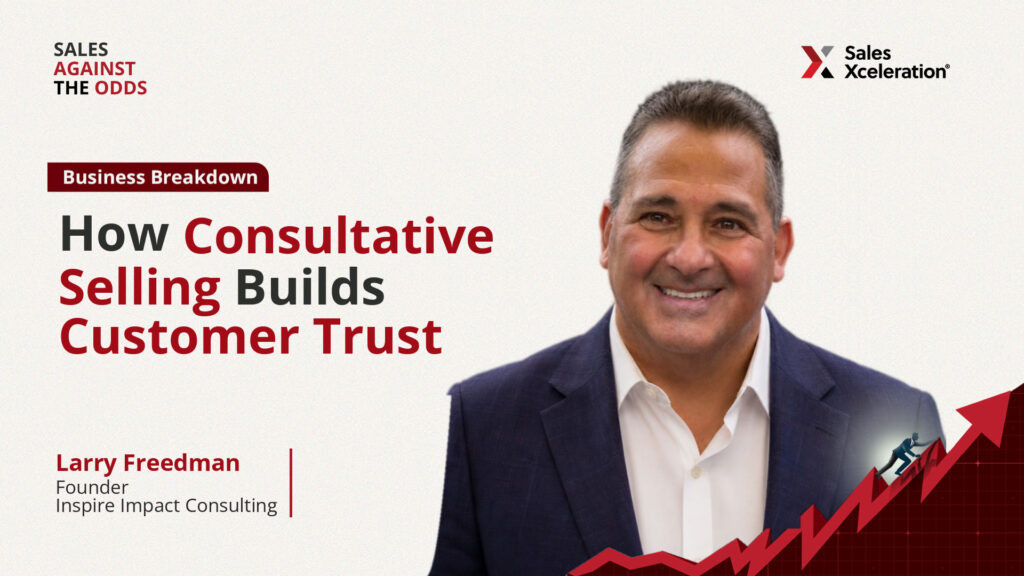
How Consultative Selling Builds Customer Trust with Larry Freedman
How to Build a Powerful Network and Personal Brand with Kelly Crandall
How To Become Irreplaceable To Your Customers with Scott McKain
Related Articles



Subscribe
Share This Episode
Episode Highlights
(00:00) Introduction
(01:14) Larry’s journey from broadcasting to sales
(02:47) The balance of support and demand in great sales leaders
(04:13) What makes the best pharma reps: product knowledge, selling skills, and relationships
(07:31) The “friend zone” in sales
(09:23) The talk-to-listen ratio and consultative selling
(10:53) Trial closes: the most underused tool in sales
(21:06) How AI is changing targeting and small business operations
(23:32) Breaking the status quo
About the Guest

About the Host
