
Summary
A Fractional VP of Sales doesn’t manage a sales organization by being physically present, but by installing operating cadences that make the organization self-managing. Weekly pipeline reviews catch stalled or poorly qualified deals early, monthly reviews diagnose whether underperformance is a people or process problem, and quarterly resets keep territories, messaging, and staffing aligned with company growth. This article explores how these three cadence layers work together so sales performance stays visible, measurable, and self-correcting with or without the VP in the room.
A $200K full-time VP of Sales hire doesn’t fit the budget for most growing companies. So, you’re looking at a Fractional VP of Sales instead – and wondering how someone who’s only in your building a few days a month can actually run a sales organization. That skepticism is fair.
The fractional model works because a strong Fractional VP of Sales doesn’t manage by presence, they manage by installing operating cadences that make your sales organization self-managing. Once those rhythms are in place, they surface problems, enforce accountability, and drive decisions whether the VP is in the room or not.
Why a Fractional Model Works
A Fractional VP of Sales operating cadence works across three layers, each addressing different time frames:
- Weekly pipeline reviews catch deal-level problems before they cost you revenue.
- Monthly performance reviews diagnose whether you have people problems or process problems.
- Quarterly strategy resets keep your sales motion aligned with where the company is actually headed.
Together, these cadences create the infrastructure that turns a collection of individual salespeople into a predictable revenue engine.
Weekly Pipeline Reviews: Catching Problems Before They Cost You Revenue
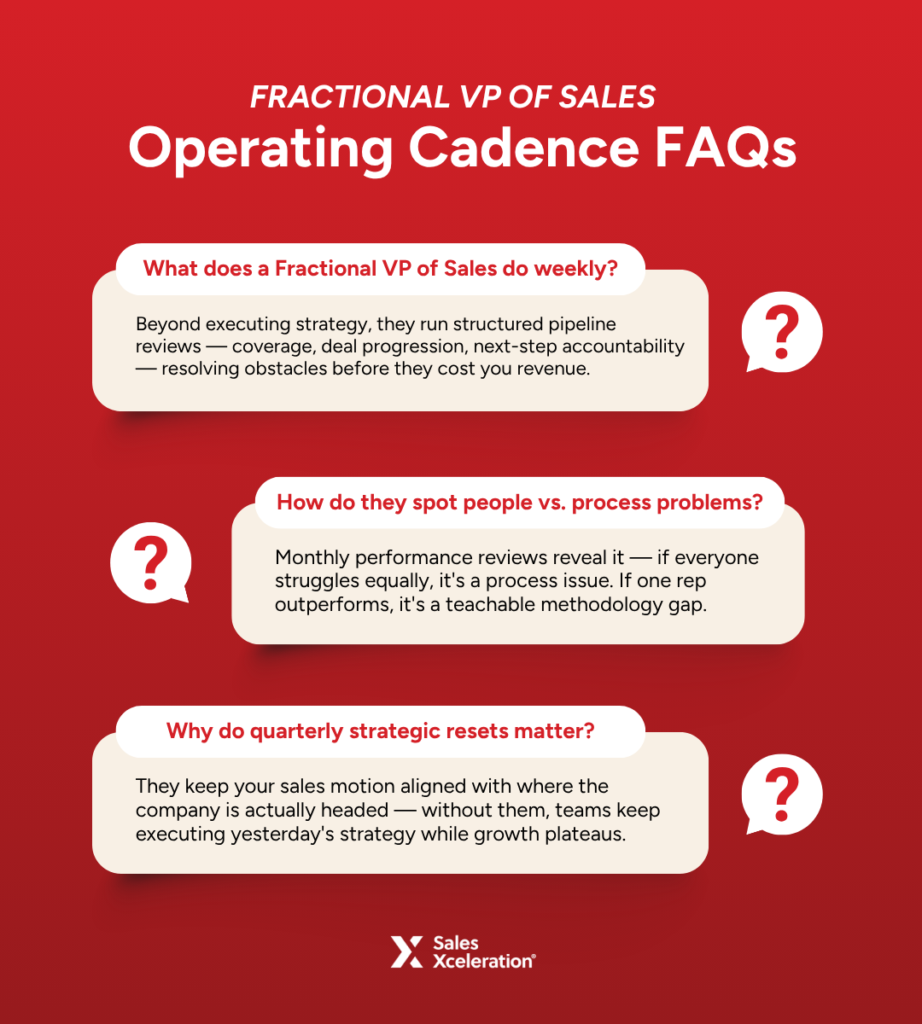
Most small sales teams default to hope-based pipeline management. Deals get discussed only when the forecast is already in trouble. In other words, hope is not a strategy. The weekly cadence replaces that with deal-level inspection that delivers immediate value by covering four critical stages:
- which opportunities are advancing,
- which are stalled,
- what is blocking progress, and
- who is accountable for moving each deal forward.
Without this discipline, deals quietly slip a month or more because nobody asks the hard questions about deal health until it’s too late.
The stakes are real: McKinsey’s analysis of nearly 500 B2B companies found that top-quartile sales organizations generate roughly 2.5x the gross margin per sales dollar invested compared to their bottom-quartile peers. Within this analysis, they identified a weekly steering cadence as a key structural differentiator.
A typical weekly pipeline meeting follows a specific structure.
- Pipeline coverage analysis: do you have enough qualified pipeline to hit quota, or are already behind before the month starts?
- Deal progression review: what moved forward this week and why?
- Obstacle identification: what is preventing closes and are those obstacles are within your control?
- Next-step accountability: who is doing what, by when, in terms specific enough to verify next week.
This structure makes it impossible for deals to weaken in the pipeline with vague next steps like “following up” or “waiting to hear back.” Across thousands of client engagements, the pattern is the same: without weekly pipeline discipline, deals slip because no one confirms that the contact who “loves our solution” actually has budget authority or that a verbal yes is backed by a signed agreement to move forward.
This is where the fractional model earns its keep: the VP manages through metrics and systematic questioning that your sales manager can replicate between sessions. The cadence itself becomes the management layer.
Monthly Performance Reviews: People Problem or Process Problem?
Monthly reviews zoom out from individual deals to team performance patterns. If every rep struggles to convert initial meetings into qualified opportunities, that’s a process issue – your discovery methodology is weak or your qualification criteria are unclear. If one rep converts at twice the rate of the rest of the team, that’s a methodology gap you can systematize and teach.
A monthly review typically covers:
- Individual rep scorecards: quota attainment, conversion rates by pipeline stage, average deal size, and sales cycle length.
- Leading indicators: whether activity levels actually predict results or reps are simply busy without being productive.
- Compensation plan effectiveness: whether you’re rewarding the right behaviors that drive revenue or paying for activities that don’t.
- Skills gaps: where reps need training or coaching to improve performance.
Most companies track activity (calls made, meetings held), without tracking the metrics that predict revenue. A 2024 Gartner survey found 84% agreed that sales analytics has had less influence on sales performance than leadership expected. This gap is exactly where the operating cadence delivers diagnostic value that founders and sales managers typically cannot provide on their own.
When demo-to-proposal conversation is consistently low across the whole team, that points to a product-market fit issue or a qualification problem – you’re demoing to people who were never going to buy. When one territory consistently outperforms the others, that points to either better territory design or a rep doing something the rest of the team should learn. Monthly reviews make sales performance measurable and improvable rather than mysterious.
Quarterly Strategic Resets: Staying Aligned with Where the Company is Headed
The quarterly cadence addresses the strategic questions that get ignored when everyone’s heads are down executing:
- Are you targeting the right customer segments?
- Is your value proposition still resonating?
- Do your territories and compensation plans support your growth goals? Or were they built for a company stage you’ve already outgrown?
It also forces a forward-looking staffing question: are you building the capabilities you’ll need six months from now, or staffing for last quarter’s reality?
Fractional leadership brings strategic thinking without the full-time cost. A Fractional VP of Sales assesses market feedback from the field – the objections reps hear repeatedly and what those objections reveal about positioning or product gaps. From there, they recommend:
- adjustments to your ideal customer profile or messaging based on win/loss patterns,
- redesign territories and action plans as the company grows so coverage matches opportunity rather than historical accident, and
- plan hiring and training investments so the sales organization is ready to meet next quarter’s targets.
Specific quarterly reset components include:
- Win/loss analysis to surface patterns about where to focus.
- Sales process optimization to identify which pipeline stages need refinement – often where deals stall or reps are inconsistent.
- Capacity planning to determine whether the current team can hit next quarter’s targets at a reasonable quota.
- Sales technology evaluation to confirm your CRM and tech stack are supporting performance, not working against it.
Companies that skip quarterly strategic reviews keep running the same sales motion even as market conditions shift. They’re working hard but not adapting, which is why growth plateaus. A Fractional VP of Sales brings the outside perspective needed to notice what has changed.
Hire the Cadence, Not the Overhead
A Fractional VP of Sales operating cadence delivers results through systematic rhythms that make sales performance visible, measurable, and improvable. Weekly discipline surfaces pipeline problems while they are still fixable. Monthly diagnostics separate people problems from process problems. Quarterly strategic thinking keeps the sales organization aligned with where the company is headed. Together, these cadences make the organization self-correcting with or without the VP in the room.
Start by assessing your current sales cadences. Wherever a layer is missing, that’s where revenue is leaking.
Find out where your revenue cadences are breaking down.
The Sales Performance Assessment shows you exactly which cadence layers (weekly, monthly, or quarterly) are missing from your sales organization, and how a Fractional Sales Leader would install the operating rhythms that drive predictable revenue growth without the cost of a full-time executive hire. Take the Sales Performance Assessment today.