
Building a Strong Foundation for AI in SMB Sales and Operations
AI doesn’t fix broken systems. It accelerates them.
In this episode of Sales Against the Odds, host Lee Brumbaugh sits down with Sam Sharma, founder and CEO of Elevate AI Tech, to discuss what AI adoption really looks like inside growing SMBs. Sam reveals why most AI initiatives fail, how poor data and broken workflows breed chaos, and why AI is more of a change management challenge than a tech issue.
They dig into real examples from sales, operations, and training, including how Sales Xceleration leverages AI to cut admin drag, boost consistency, and plug revenue leaks faster. From AI opportunity mapping to the shift from AI-enhanced to AI-first businesses, this conversation cuts through the noise and focuses on building systems that drive confidence, not just speed.
Key takeaways:
- Why AI tools fail without clean data and connected systems
- How AI opportunity mapping identifies the highest ROI use cases
- Why systems build confidence, and confidence drives revenue
This has been generated by AI and optimized by a human.
[00:00:00] Sam Sharma: Work out a plan, a model of how you will adapt and transform your business models rather than picking up another tool and every single tool has been picked, different departments are picking different tools and none of them is understanding. Well, actually the data layer is the same. If that is chaotic, the best AI tool in the world will only accelerate that chaos. It will not fix your problems.
[00:00:21] Lee Brumbaugh: There’s no silver bullet sales, but on Sales Against the Odds, we’re here to give you the best shot at building a sales infrastructure that helps you scale. I’m your host, Lee Brumbaugh. Welcome back everyone. My name is Lee Brumbaugh, CEO of Sales Xceleration, and this is Sales Against the Odds. Very excited for my guest today. I am speaking with Sam Sharma, CEO of Elevate AI Tech. Sam’s company helps leaderships turns AI into real operating systems and makes sure your tools are connected. The outcome is you get less manual work, you get tighter compliance, and you’re making faster decisions. All leads to what we’re here for today, which is growing your company. Sam, thank you so much for joining us.
[00:01:07] Sam Sharma: Thank you for having me, Lee. Great to be here.
[00:01:10] Lee Brumbaugh: So Sam, let’s jump right in. First off, I know you’ve worked with us and on different things of making us really be able to use AI from a sales perspective. But when you think about AI, you started as a technologist, a business strategist. What experience over the last 20 years of being in the space shaped how you approach AI today?
[00:01:29] Sam Sharma: So that’s a really tricky one because it’s not just one literal experience that I can pull from my hat, but a combination of experiences. But the lessons that came out for me was I was looking at a lot of these pieces that were disconnected from one another. And as they were disconnected, I was able to see that actually when we go after the technological elements, we are leaving behind the human side of how human adopts into the latest technology or the workflows. How do they actually make these things come together? And how do they not just leave things? I come across so many companies where they have tools, but only 20% of the tool is really leveraged correctly. 80% of the functionality is just sitting there because no one can be asked to use it. And the real reason for that is because it’s an artificial imposition on the mind.
[00:02:13] Sam Sharma: It’s not an extension of their natural behavior of their natural workflow to use all those aspects of a system. And that was the biggest lesson that I took away into my … I was working for complex banking environments and these technologies are very, very complex, let alone the human cost of rolling those implementations. And what I learned during that time was that you can build the most incredible system, tech-savvy system, but if the users don’t understand or adopt, the most naturally it’s going to just fall apart. And that’s exactly what was happening in many cases. So we want to give them something that’s an extension of their own experience. Human user journey, that’s the most important part for me is the user journey and the experience we want to create for users so they naturally take the next logical step while using the system.
[00:03:06] Lee Brumbaugh: That’s a great point. And so if you go in and you’re working with a company and there are obviously some disconnect as the technology you said, 80% of it’s not being used. How do you diagnose where in the workflow of that human experience is the disconnect? How do you uncover that?
[00:03:23] Sam Sharma: So the first part of the process I always do with any organization is called the AI opportunity mapping. AI opportunity mapping allows me to literally decipher all the process flows they have internally and where the pain points are coming in those processes they have as of now. Sometimes we run internal service to get hold of that information. Other times we simply look at, okay, what kind of interviews I can conduct to pull that information out of different stakeholders. Once you’ve got that information, I tend to look at, okay, what’s the lowest hanging fruit which will have the highest impact to turn that into an AI or an automation piece? That’s where the real game changing take place. So we are able to work with an organization and break it down into multiple opportunities. Within those opportunities, we call them projects. Within those projects, we say, right, which is the project that really is the biggest game changer for you?
[00:04:16] Sam Sharma: And as a business, the most important question business owner need to ask really is not like, what can AI do this for me? That’s the features question. What we tend to look at is what’s the biggest revenue generation system you have that we can protect right now and enhance? So that’s where the focus goes into, from a consulting perspective, I’m always looking for, okay, what’s that little thing that we can, if we were to turn that into an AI or an automation, we’ll give the highest impact to the organization in terms of its revenue or securing their reputation or making them a market leader. That’s where my focus always stays.
[00:04:54] Lee Brumbaugh: Yeah, it’s very similar to us. I mean, we’re going in. Obviously our advisor community is working in sales strategy execution, but typically there’s clearly one area low hanging fruit where you can deliver the quickest ROI and be able to show that business of your skillset and what you’re doing and begin that journey. So well, Sam, you know that obviously most of what’s going to be turning in today is the SMB space, which you’ve worked in. From a sales perspective, I know you’ve done a lot of things on the sales side. Where’s AI going from a sales perspective? What works? There’s a lot of noise. I just had a podcast last week with Donald Miller and he talked a lot about the noise. We get 70 touchpoints, so it’s clarity and message. And so we get a lot of emails, outreach, and it’s almost like this constant outpouring of what’s coming to us.
[00:05:40] Lee Brumbaugh: What are you excited about from a sales perspective? Where is AI going that will benefit SMBs in the sales space?
[00:05:47] Sam Sharma: Yeah. So if I was to answer that question from a more basic fundamental, which was about when we were designing any workflow, we look at the sales funnels. And at each level of those sales funnel, we look at what AI tools can help me support two main things. One, can I predict what the customer’s looking for? Second, how do I know they’re looking for something out there? So making that prediction using analytics, it allows me to really leverage different AI tools at different stages. But this conversation is not about tools. This is more about strategy of how we can lead them in a certain direction. Like for example, in our case, what I see where the world is heading, you’ve got agentic stuff orchestration, which is going to be a real big thing. What that really means, an operating system where AI will be able to handle data, decisions, and actions on behalf of the business.
[00:06:37] Sam Sharma: That’s the first part that I see really where the wave will go because everyone will say, “Okay, can you do it for me? Can you literally take care of this bigger piece for me? “ And then I will come on top to make my more comprehensive input on top of that. Just like Sales Xceleration, sales discovery report in which AI will do the heavy lifting, but then you’ve got sales advisor putting the icing on the cake saying, “Here’s what it is. “ So all those pieces will come together. That’s the first part. The second part is the SLM, which is small language models. So large language models is what got the most noise, but SLM simply means that we deploy the AI instance inside your secure organization, inside the network of your organization, making it more intelligent with the data and the documentation you have already got internally and locking that down with the department level.
[00:07:29] Sam Sharma: So for example, SXPortal is a great example of that. If SX portal was to build on top of a search engine where the chat internal SLM helps people simply act like a GPT tool and interact with the portal and portal then just literally retrieves and gives all the information that the advisor is looking for. It explains, it tells them the documents, it gives them the location of the document and so on. So suddenly they don’t need to use the website as an old way of looking at things. It’s a context driven usability where the portal will go.
[00:08:08] Lee Brumbaugh: And I think I’ve got this and this is great clarification on this. So we’ll use Sales Xceleration as an example. So obviously within our database, we have tools that we use to deliver for companies anywhere from center plans to sales process types of things. But I guess what you’re telling me is where we’re heading is we’re going to have the ability to use AI to only find the tools, but enhance the tools, communicate with tools. So a static PDF is no longer static PDF. It’s enhancing utilizing the AI to build, make better, and go forward.
[00:08:37] Sam Sharma: Exactly. Exactly. Why do I need to click on a PDF to read what’s inside the PDF when I can interact with that PDF on one same interface, right? So suddenly the games change. The whole experience of how the user is looking at a data, retrieving the data, making a decision is all intertwined in one interface alone.
[00:08:56] Lee Brumbaugh: Love it. Going back to your first point, you say predicting customers and then mapping to the journey of where that customer prediction is. Can you give us a real world example of what that could potentially look like? So let’s say I’m a $10 million company. I know you’ve worked with a lot of financial companies and you’re looking for, it’s a financial company that does wealth management and you’re looking for people that are engaged in that level. How does that predictive portion, give us some examples there of where that could fit in the space for?
[00:09:23] Sam Sharma: Well, from the predictive space, instead of giving you a financial example, I can give you an e-commerce example which is more relevant in this context. You’ve got a buyer coming on your website to purchase something. Imagine the first layer of your first level of defense or AI will be your chatbots. What are these chatbots doing? There are two types. One is a conversational, which is all about texting and typing. The other is spoken conversation taking place. These chatbots act as your sales representative guiding you into the digital store. Now they are monitoring what you’re looking for. They’re asking for if you need any help. And if they observe that you get stuck at some certain aspects, they will encourage you to make the purchase by using a discount code. They can create an offer. They can say, “Oh, did you know we’re just running a campaign?
[00:10:10] Sam Sharma: Oh, by the way, there’s a campaign coming up in two days from now, which will allow you to have 10% off on that specific product.” So it’s continuously monitoring where you’re going, where you’re heading, what’s your behavior, how are you going to be thinking, what’s your analytics behind in terms of user journey? We have mapped you out right from the moment you land on the site till the moment you make a decision to complete the purchase. A bot is with you and it’s at scale, which means thousand people have their own individualized bots, sales assistance, guiding them to make a decision and helping you answer all the questions while giving you a discount offers. By the way, did you know there’s a discount on this if you use this coupon code. So suddenly it takes it to a next level of a user experience where a bot acts like your individual, your personalized sales assistant who’s walking by you, helping you make a better decision in the shop.
[00:11:03] Sam Sharma: Same thing can be taken into other context. So I can literally pick that up into the wealth management space and say, right, okay, so how do we know we can make an interest rate decisions while actively monitoring the real time credit scoring of an individual? And based on that active monitoring of credit score, we adjust the interest rates of credits we need to give out. So it can go as deep as you want depending upon what’s the use case behind how it’s been built. That’s where it ultimately comes down to. And every business is different. There’s a lot of noise in AI and the noise really comes from because we’ve been bombarded with all these tools. But if you scrap all that noise out and look at the real core function, there’s only three things. We want to save time, we want to make money, we want to scale businesses without hiring.
[00:11:53] Sam Sharma: So how do we do these three things? Well, it could be combination of things. So for example, there is gen AI, there’s a Gentic AI, there’s workflow orchestration, there’s LLMs, there’s NLP, there’s machine learning taking place. You don’t need to worry about all of that. For example, when I was working with Sales Xceleration, when we looked at the tool that we developed for the SX part, we’ve combined multiple things in one tool. For a user, it’s AI, but underneath that AI, there is machine learning happening, there’s gen AI happening, and there’s an Agentic workflow behind it, but you don’t need to worry about it because we’ve taken care of that for you. So it all depends upon who are you listening to. And AI adoption is more about, one, having the right AI partner with you, and secondly, understanding that it’s less of a technology, more of a change management
[00:12:44] Lee Brumbaugh: Issue. Yeah, that makes a lot of sense. And the change management part, I’m sure, is the trickiest part, right? Human, right?
[00:12:52] Sam Sharma: And humans are fundamentally fallible.
[00:12:55] Lee Brumbaugh: Yeah. So Sam, as you go through this, you’ve talked a lot about it working and you’re mapping with the individuals, you’re getting buy-in, but even then we know AI initiatives stall out. What’s the biggest reason? What’s the biggest reason you see AI initiatives not get to the juncture of where the company wanted to get it to?
[00:13:13] Sam Sharma: Yeah. So there are a few reasons what I found is that one of them is a lot of companies, they will stay at an MVP level and that MVP, they will make a minimum viable product, they will work through everything and then they will kind of panic, oh, shall we make the move and make the transformation happen or shall we just sit while something else needs to happen? So that’s one of the reasons that I have seen such transformation or adoptions just stall in the middle, literally they stall. The other things I can think of is AI adoption itself is tricky. So unless they have people in place to work with someone like myself, like someone accountable within the organizations to work with an AI company to have that transformation happen, it seldoms get adopted because CEOs don’t have enough time to just say, “Oh, just do it by yourself.” The third thing I found is that sometimes I find there is a conflict between the team members and the CEOs in terms of how they perceive AI.
[00:14:12] Sam Sharma: So sometimes CEOs are way ahead than most of their own employees and they’re very driven. They’re like, “We want that. “ And employees are panicking thinking, “Oh, maybe this will take our job away from us.” On the other side, we’ve got employees who are very willing, they jump in, they adapt, they’re fast. Whereas business owner is thinking, “I’m getting out of hand. This is getting out of control. How do I manage all of this? “ I have seen both sides, but AI adoption, as I said, it’s more of a change management problem than a tech problem. And it’s really easy to ignore and people under pressure, they’re going to make mistakes. So one of the key mistakes I’ve find people do is they will jump onto one of the AI tools without any guardrails and upload one of the company’s confidential documentation because company was encouraging people to use AI without any guardrails around it to see what are the best practices of how you should be using AI.
[00:15:05] Sam Sharma: So these are the kind of things that you will always get problematic with. Then a lot of people throw these articles at me like, oh, there’s only 5% of the companies that got an ROI back on their AI. But when you actually look at the whole article, it clearly talks about the companies that they got the results back were the companies that came to AI with a clear set of metrics of what they wanted to measure against, rather than just saying, “It’s not a feel good factor.” It’s not like when they say, “Oh, one of the questions that you had was, is the company ready?” Or, “I want something with AI.” What does that mean? It means that, well, if I want something, what I’m really saying is I want to grow my revenue, I want to increase my business. That’s what I’m really saying.
[00:15:49] Sam Sharma: But if I’m ready, it means I’m ready to do work at the data level, at the process level, at the change, because your workflows will not stay the same once the AI is inside the workflows. And that’s one of the key things. They fail to understand that your workflow and the depth of AI inside your workflow will become your USP that other companies don’t have. So it’s not about everyone else using ChatGPT and we should use ChatGPT. It’s about where does that AI sits inside your own personalized workflow that no one knows about? That’s where your USP is.
[00:16:27] Lee Brumbaugh: Most companies don’t have the bandwidth to build a high functioning sales department to allow them to meet their revenue targets. With Sales Xceleration, they don’t have to. Our experienced fractional sales leaders consult and implement your sales strategy, infrastructure, management, and team development. Discover how we deploy these proven sales solutions to address your sales challenges by going to our website, filling out the contact form. We’d love to hear from you. So you mentioned … I’m going to go back to clarifying point there. You talked about measuring the ROI and building. How do you come alongside a company and map that at the onset? What does good look like from a … So you’re a company and you’re thinking about making a significant investment in the AI space, and that’s a big deal for a lot of the SMB companies that we work with. What’s a good way to measure that ROI?
[00:17:17] Lee Brumbaugh: What’s that look like?
[00:17:18] Sam Sharma: When we talk about ROI, we look at the bigger picture first, and that’s where the AI opportunity mapping comes in. You can’t look at things from isolation. Let’s say your sales department is using one tool, your marketing is using another, your operations is using another, and your finance is using another. What they’re failing to understand is all of them are leveraging the same data. And if the data is not clean, your outputs will vary and the CEOs will get confused in the numbers and will not be able to trust the output itself. And that itself lies the problem. So when we are looking at … When we do the AI oppportunity mapping, we tend to look at, okay, so what’s the lowest hanging fruit that has the highest return if we were to solve that specific problem in that process? If I was able to take away the pain of, let’s take SDR, for example, every single advisor coming from different background, different way of articulating their ways of saying things, of writing things, right?
[00:18:14] Sam Sharma: So what we have done here, we’ve got variations of human cognitive abilities. Suddenly we put an AI tool which saying, “Well, this is your bar standard. We expect this standard to be hit now for every single output that goes out of SDR.” So suddenly the standards have been raised and they’ve been made into a consistent place. So we have taken away the human inconsistency straightaway. That’s the one thing. So standards have been raised and it’s consistent throughout the SDR process at least.
[00:18:43] Lee Brumbaugh: And for the audience, just to fake pause tracking with, we have a sales development part. It’s called our SDR and that’s where we build out. We work with the company, a series of interviews to really at the most core level to analyze the strengths and weaknesses of organization based on sales strategy, methodology, execution. It was a very manual process. We were taking a lot of these questions, having to go back and type them into a document, and then there was a lot of work that went for our advisor community. So level setting of, that was a lot of time consumption that went around that. So Sam, keep going for the audience and keep elaborating because I think it’s a good point.
[00:19:19] Sam Sharma: Yeah. So what we have done in that case, we have not only taken away the pain of varying cognitive abilities, we have also cut down the time from what was taking five, six, seven days to less than half an hour now. And we are retraining the advisors to think of how to approach a sales discovery process in a new workflow methodology, whereby we remove the pain out of their process so it’s much easier. And at the back of the output, you’ve got that beautifully conducted PDF that can go out to the end client by saying, “Here are our findings, here are our recommendations, and that’s how much we’ll be to work with us in order to deploy these solutions.” So the sales infrastructure straightaway, you’ve got the advisors infrastructure like, wow.
[00:20:03] Lee Brumbaugh: Yeah. And I think the other part of it too is from a consistency standpoint, improves us. But also from an AI perspective, you’re looking at what are the best practices in writing a sales process in a lead generation. So it’s not only helping us be more efficient, but it’s enhancing, it’s bringing in competition. It’s really taking what the marketplace is doing and allowing us not only for what the advisor’s bringing to that engagement, but what the best practices within Sales Xceleration because that’s our goal, right? I think through this whole process, we worked over, we’ve helped over 5,000 companies grow their revenue line. So we need to learn from what we’ve, those commonalities of what has worked and share that into the advisor community. And I think you’ve done a great job of helping us and continue to expand there.
[00:20:47] Sam Sharma: Very true. And that’s one of the key things that you will see where we earlier, we touched upon the revenue leaks that takes place in today’s world. And one of the key things we find is your delays in follow-ups is one of the biggest reasons where the revenue leaks. So if it was taking ages to complete an SDR process, let alone the other tools inside the portal, suddenly that problem is solved. We will strike where the iron is hot. You’ve just conducted the interview in a day or so, go back with a full detailed report of your findings. So you have qualified, you have prioritized, less admin drag, and there is no follow-up delay. Straightaway, we have patched up all the areas where revenue was leaking.
[00:21:34] Lee Brumbaugh: Yeah. And allows us to benchmark against other just so much that we’re excited for where these builds will go for how we deliver with clients. So Sam, when you think about what you’ve learned in this process of what you’ve seen, where AI started, where you are today, any aha moments of as you were working on something and you realized this is going to work so well for the company or not, how has AI evolved? What have been the aha moments that you’ve learned through this process?
[00:22:02] Sam Sharma: Yeah, that’s a really good question. So what I’ve always found was AI was a true extension of human capability. AI actually means what? Artificial, because it’s computer generated. Intelligence, because it has the cognitive ability to connect the dots like humans do. And we don’t connect dots logically, we connect dots randomly. And that’s what it’s doing. It’s actually in a mathematical format trying to predict what’s the next likely outcome you are after. So when it came out, I was like, we were already working in the tech space for a long time, understanding the automations pieces, and we started to integrate some of these automation pieces together inside the workflows, and the results were phenomenal, especially in the space of identifying the most trending posts or news items, re-articulating those, recreating them, creating imagery, and posting it straight on your social media networks. So we have a whole workflow defined and it started to do miracles for us, let alone the visibility, but it was striking the nerve each time of the audiences we were connecting with.
[00:23:08] Sam Sharma: And I think that workflow is a must have workflow that eventually everyone will have. But as I said, your real game changer will be the workflows that you follow inside your own organization or your own practice. So that was the first phase that happened. Then came the AI tools that you have a choice. You can either be an AI enhanced business or you can be an AI first business. The real difference between the two, AI enhanced is, “Oh, I like that tool. Can I have that tool integrated?” AI first means I want the decisions to be made at the back of AI. To give an example of SX, that’s a great example for us. So having an SDR AI tool, that’s a tool that’s sitting on top of the preexisting portal. Portal becoming an AI driven, context driven tool that literally does the whole lot for you with the chat interface.
[00:24:04] Sam Sharma: It’s an AI first business. So where is the decision making taking place? That’s where the core differentiator will be. So when we started to experiment with decision making systems, then came the SLMs came out. SLM was a great way of write, okay, I’ve got my organization, I’ve got these new people starting, people leaving, I’m losing the knowledge from the organization. I’ve got new people on my case trying to see, can you show me this? Can you tell me where to find this? All that time wasted. SLM allows me to train a small language model on all of my company documentation. One. Second, put guardrails in place so I can departmentalize it. So for example, certain documents can only be accessed with finance. No one else can look at that. Certain will be only with human resources. No one else can access that. So all of that, the model’s been trained on.
[00:24:54] Sam Sharma: Now, any new starter comes and says, “Give me an SOP on how to do the sales discovery.” It’s all laid out. Right now I can train the SLM on my own personal experiences and I can say, “Well, I’m Sam and I’ve got this experience. Can you write it specifically for me? “ So you see happened the two contexts came together, me as an individual personalization. It embodied that into the organization and gave me a custom solution just on my specific needs. Why? Because my cognitive ability might be different from yours. You may be super smart and I’m not that smart. So I want your solution to work for the person you recruited. So certainly the training changes, which means it’s a personalized training that addresses my weaknesses, not just generic weaknesses. It’s a game changer. You see what I mean? Now the senior management doesn’t need to waste their time anymore.
[00:25:43] Sam Sharma: They say, “You know what? Why don’t you go and use our SLM and just ask a question and it’ll train you on … Just go and there ask them to create a training program for you. It’s going to do it for you based on company documentation that you are allowed as per your titles to access.”
[00:25:58] Lee Brumbaugh: Yeah, it’s amazing. Yeah. From a training perspective as well enhanced, but there’s just so much you can do here. Now, let’s say I’ve got a last question for you. You mentioned enhanced and you mentioned first. Let’s say you’re listening to this podcast, you’re a $10 million company, you’re a family, a fourth generation company in the business. And when you talk about AI, you’re like, “Well, we’ve heard of ChatGPT.” Let’s say we’re not enhanced, we’re first, we know we’re behind from that perspective. You’re trying to break in. You’ve got a sales team, you’ve got … Where would you start for that company that really hasn’t done much to anything from an AI? They know they need to be able to stay current and not get behind from a competitive standpoint. Where would you start? So I always say AI
[00:26:43] Sam Sharma: Opportunity mapping is your step one. That involves couple of workshops, just making sure that we sit back rather than jumping onto the tool. We take a step back and say, “Right, what’s the process here? What are we really trying to do? Where is where AI can really leverage? You see, the problem is most people don’t see the use cases. Because you don’t know the use cases, you will never understand why you need to go through the AI opportunity mapping because AI opportunity mapping is allowing you to identify a use case. I would have never given you that voice-based solution if I did not know the pain points of the advisors that the reports were not getting completed. And when I looked at the human element of that, I was able to identify actually speaking to someone is much easier than sitting there and typing a long report on someone.
[00:27:30] Sam Sharma: So why don’t I speak my report out and let AI do the hard work for me? “ So that’s where you will see in 2026, a lot of the adoption will be around the voice piece. And you guys are way ahead already because you’ve gone, not just adapted just any tool, you have customized that inside your workflow.
[00:27:47] Lee Brumbaugh: Yeah, but you’re right. It did start with an AI mapping session that was customized to us and needs to be customized to the client.
[00:27:54] Sam Sharma: Exactly.
[00:27:55] Lee Brumbaugh: Well, Sam, this has been great. I mean, there’s so much that obviously your company has built for us. We’re so grateful of where we’re going as a company that’s been trying to be first and enhanced from both this perspective, from an AI perspective. Thank you so much for joining us today. This has been very helpful. And if an SMB company is at that AI mapping stage, is it directly reaching out to you and your company? Walk through of where you position your company in that phase before we
[00:28:22] Sam Sharma: Conclude. Yeah. So the way I see that is if you know you need to do something with AI and you don’t know where to start, it’s a bit overwhelming. We should have a chat. If you are a CEO, CEO sitting there thinking, “Well, we’ve used all these AI tools. We didn’t get any returns. I can promise you that’s because it was never mapped out into your process journeys. You just jumped on for a shiny object syndrome. That’s all that happened there.” So you just need to take a step back and work with myself and work out a plan, a model of how you will adapt and transform your business models rather than picking up another tool. And every single tool has been picked. Different departments are picking different tools and none of them is understanding. Well, actually the data is the same. The layer, data layer is the same.
[00:29:06] Sam Sharma: If that is chaotic, the best AI tool in the world will only accelerate that chaos. It will not fix your problems, right? It will still enhance it. So you still need to take a step back and think this logically. And I always say, tools will increase the speed, 100%. Systems will increase your confidence. My question to you is revenue. Is it grown on tools, speed or confidence? Revenue always grows on confidence. So if you’re running after tools, you’re increasing the speed, but it’s the systems that increasing the confidence. So think from a system perspective. And for system perspective, you need to work with someone who’s got that system background.
[00:29:47] Lee Brumbaugh: Or the tools just sit and get dusty. So that confidence level, that human element, that mapping is so critical.
[00:29:52] Sam Sharma: Gathering digital dust.
[00:29:54] Lee Brumbaugh: Sam, thank you so much for joining us today. This has been great. Uh, thank you everyone for joining Sales Against The Odds. Please turn in and in two more weeks, we’ll have another business leader that talks about an element of how to grow your business.
[00:30:05] Lee Brumbaugh: Thanks for joining us, Sam.
[00:30:07] Sam Sharma: Thank you, Lee.
Our Recent Podcasts

Scaling Beyond the Ceiling: EOS, Accountability, and AI with Jason Green

20 Sales Lessons from Our First 20 Guests You Can Apply Today
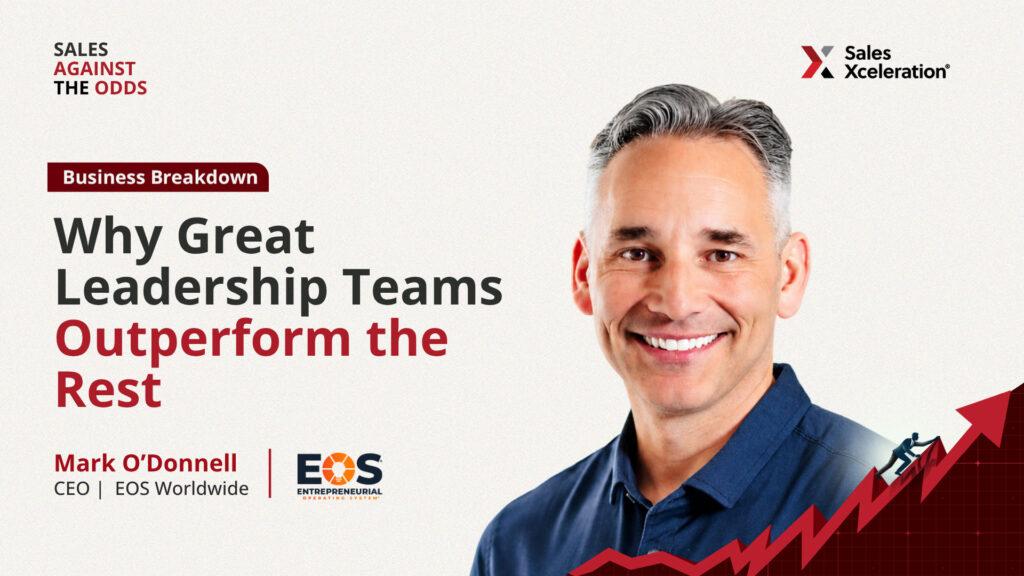
Why Great Leadership Teams Outperform the Rest with Mark O’Donnell
Related Articles



Subscribe
Share This Episode
Episode Highlights
(00:00) Introduction
(01:10) Sam Sharma on 20 years in tech and the human side of AI
(03:23) Find workflow gaps with AI opportunity mapping
(05:12) Where AI fits in sales for prediction and smarter plays
(09:23) Real examples of AI in action from clicks to conversions
(12:31) Why AI rollouts stall and how to get real adoption
(16:59) How to measure ROI before you buy the next tool
(21:41) What is next for AI and personalized sales training
About the Guest

About the Host
